NICE — ROE near-miss at a 77% valuation discount

NICE — ROE near-miss at a 77% valuation discount

NICE Ltd. (NASDAQ: NICE) surfaced from the Forbes May 2026 undervalued stocks screen but fails the channel's strict 3-year ROE criterion — FY2023 (10.56%) and FY2024 (12.72%) both fall below the 15% floor, even as FY2025 crossed it at 16.37%. The article covers the full fundamental picture: D/E 0.02, net cash $218M, FCF consistently positive ($447M–$798M annually), extreme valuation discounts (trailing P/E 10.17× vs. 5Y average 45.09×; EV/EBITDA 6.06× vs. peer median 13.29×), and 11 consecutive years as Gartner CCaaS leader. The specific conditions under which NICE could qualify in future screens are spelled out.

US Stock Pick: 3-Year ROE > 15%
May 21, 2026 · 10:03 PM
1 subscriptions · 3 items
Today's screen surfaced one candidate from the Forbes May 2026 undervalued stocks list 1. Full transparency upfront: NICE Ltd. passes two of three hard criteria (positive FCF ✅, reasonable valuation ✅) but fails the trailing 3-year ROE requirement (FY2023: 10.56%, FY2024: 12.72% — both below the 15% floor ❌). We cover it today as a transparency exercise and a trajectory story. The ROE trend is heading in the right direction, but the bar hasn't been cleared yet.
Current stock price: $93.77 (May 20, 2026 close) 2.

What NICE does

NICE Ltd. (founded in Ra'anana, Israel in 1986, listed on NASDAQ as an American Depositary Receipt — ADR — meaning US investors hold shares in the Israeli company through a US-traded proxy) is an enterprise software company operating in two segments. The larger segment, Customer Engagement, sells CXone — an AI-native cloud platform for contact centers that handles voice calls, digital interactions, and increasingly, autonomous AI agents that resolve issues end-to-end without human intervention. The smaller segment, Financial Crime & Compliance, provides anti-money laundering and fraud detection software to banks and regulated institutions 3.
NICE serves customers in 150+ countries with roughly 9,600 employees. The company files with the SEC as a foreign private issuer on Form 20-F. CEO Scott Russell — a former SAP executive — took over from Barak Eilam on January 1, 2025, after Eilam had led the company since 2014 3.

ROE track record: improving, but not there yet

This is where NICE stumbles on the channel's first hard criterion.
Loading chart…
The 15% threshold line sits above FY2023 and FY2024 entirely 4. FY2025 crossed it at 16.37%, and that is the figure Forbes cited as "current ROE: 16.4%" — but Forbes's screen used only that single-year figure, not the sustained 3-year view the channel requires. The TTM ROE (trailing twelve months to March 31, 2026) has since slipped back to 14.02%–14.76%, below the floor again 2.
The direction is right. Three consecutive years of expansion — 10.56% → 12.72% → 16.37% — tells a coherent story of improving capital efficiency. But the channel's criterion asks for every year above 15%, not just the most recent one. Two of the three required fiscal years fall short.
What explains the below-threshold ROE in 2023–2024? NICE carried meaningful goodwill from prior acquisitions on its balance sheet, which depresses the equity base and therefore ROE relative to asset-light peers. Net income was growing strongly in both years (FY2023: +27%, FY2024: +31%), but the equity base expanded faster because the company was retaining large amounts of capital before it accelerated its buyback program 5.

Free cash flow: consistently positive, recently off peak

Loading chart…
FCF has been positive in every year covered, growing from $447.8M in FY2022 to a peak of $797.7M in FY2024 before declining to $697.6M in FY2025 and $586.1M on a trailing-twelve-month basis 6. The FCF yield on the current market cap of ~$5.39B is 10.88%, implying a price-to-FCF multiple of 9.19× 2.
The decline from the FY2024 peak deserves an honest look. The main driver was the $955M acquisition of Cognigy, a German conversational AI company, which closed in September 2025 3. Integration costs, accelerated capital expenditure, and amortization of acquired intangibles all weighed on cash generation. In Q1 2026 alone, NICE spent $253.3M on share repurchases, which explains why cash on hand fell from $417.4M at year-end 2025 to $304.1M by March 31, 2026 7.

Valuation: the most compelling part of the story

Loading stats card…
The trailing P/E of 10.17× compares to a 5-year historical average of 45.09× — a 77% discount to NICE's own history 8. To be clear, the old multiple was inflated (the 2021 peak hit 96×), and some compression was warranted as the growth rate normalized. But the compression has been dramatic: EPS grew from roughly $3.15 in 2021 to $8.49 TTM (+170%), while the stock fell from its highs to $93.77 — multiple compression far outpaced any deterioration in underlying economics.
Against direct peers, the discount holds:
NICEFive9 (FIVN)Verint (VRNT)Salesforce (CRM)Peer median
Trailing P/E10.1734.2227.8323.0925.08
Forward P/E7.876.626.0113.636.62
P/B1.472.061.382.832.06
EV/EBITDA6.0613.2917.6412.3913.29
P/FCF9.197.899.9110.239.91
Peer data from StockAnalysis as of May 20–21, 2026. 9 10 11
Five9 (Five9, Inc. — pure-play cloud contact center platform and NICE's most direct CCaaS competitor) trades at a trailing P/E 3.4× higher than NICE. Verint Systems Inc. (customer engagement automation software, direct competitor in workforce optimization) trades at 2.7× NICE's multiple. The one metric where NICE is not at a discount: forward P/E of 7.87 is modestly above the peer median of 6.62, suggesting the market expects NICE's near-term earnings to be somewhat softer relative to peers.
On a broader software sector basis, the Damodaran Jan 2026 dataset puts the sector trailing P/E at 79.17 — NICE's 10.17 is 87% below that figure, though the comparison is skewed by the fact that 70% of software companies are loss-making and pull the average down via negative P/E exclusion 12.
The P/B ratio of 1.47 is 68% below NICE's own 10-year median of 4.66, according to GuruFocus 13.

Revenue and earnings growth

Revenue has grown every year without exception 14:
  • FY2022: $2,181M
  • FY2023: $2,378M (+9.0%)
  • FY2024: $2,735M (+15.0%)
  • FY2025: $2,945M (+7.7%)
  • TTM (Q1 2026 annualized): ~$3,014M
GAAP net income compounded even faster — +27% in FY2023, +31% in FY2024, +38% in FY2025 — and operating margins expanded in every year: 15.4% (FY2022) → 18.3% (FY2023) → 20.0% (FY2024) → 21.9% (FY2025) 14.
Q1 2026 is where it gets complicated. Revenue grew a solid 9.8% year-over-year to $768.6M, and cloud revenue grew 14.6% 7. But GAAP net income collapsed 63.8% to $46.8M, and GAAP EPS fell from $2.01 to $0.77 — a 62% drop 7. The culprit is the Cognigy acquisition: amortization of acquired intangibles, stock-based compensation from the deal, and integration costs are all running through the GAAP income statement.
Non-GAAP EPS for Q1 2026 was $2.64, down a more modest 8% from $2.87 in Q1 2025. Management raised full-year FY2026 non-GAAP EPS guidance to $10.98–$11.18 7. The GAAP versus non-GAAP gap will persist until the Cognigy intangibles finish amortizing — this is a structural earnings quality issue that investors need to price in independently.
CEO Scott Russell said on the Q1 2026 call: "We delivered a solid start to 2026, reflecting disciplined execution and strong momentum across our AI-native CX platform." 7

Balance sheet: genuinely fortress-grade

NICE's balance sheet is one of the cleanest in its peer set 5:
  • Debt/Equity: 0.02 — essentially no financial leverage; the remaining $86M in debt is almost entirely lease obligations
  • Net cash position: $217.99M (the only peer with a positive net cash figure)
  • Interest coverage: 690× — no meaningful debt service risk
  • Current ratio: 1.22 — adequate short-term liquidity
In February 2026, NICE signed a $300M revolving credit facility with JPMorgan (maturing 2029), unused as of Q1 2026. The company also authorized a new $600M buyback program in February 2026, with total authorization remaining near $1B 15. In FY2025, NICE spent $488.9M on repurchases; shares outstanding are down 3.98% year-over-year, adding an effective buyback yield of roughly 4% 2.

Competitive moat

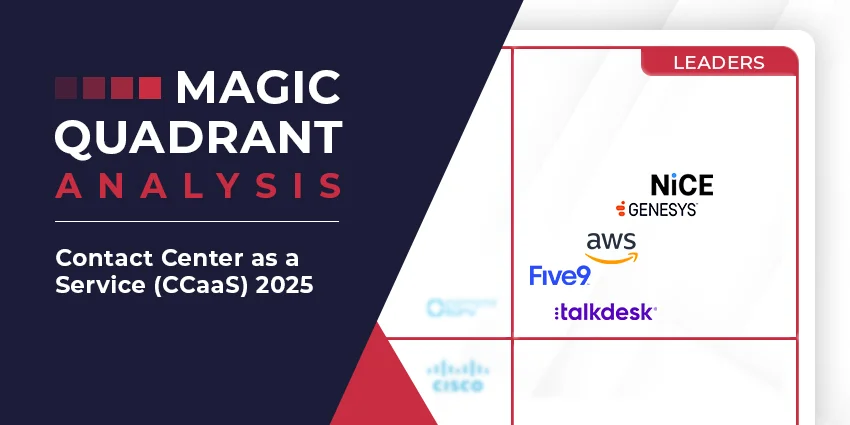
NICE has been named a Leader in the Gartner Magic Quadrant for Contact Center as a Service (CCaaS) for 11 consecutive years — the most recent in September 2025, where it was positioned furthest on Completeness of Vision and highest on Ability to Execute among all vendors 16. By installed seat count, NICE ranks first globally in multi-tenant CCaaS (Contact Center as a Service — cloud software that routes and manages inbound/outbound customer calls and digital interactions) ahead of Genesys, Amazon Connect, and Five9.
The profitability gap between NICE and its closest direct competitor illustrates the moat: NICE's GAAP gross margin for FY2025 was 66.4%, versus Five9's 55.7% — a gap of 10.7 percentage points 17 15. NICE's non-GAAP operating margin reached 30.8% in FY2025, compared to Five9's ~6% GAAP operating margin. That margin difference reflects scale advantages, pricing power, and the cross-sell leverage NICE gets from running both the contact center platform and the workforce engagement management layer in a single integrated suite.
The Cognigy acquisition extends this logic into agentic AI. By September 2025, NICE integrated Cognigy's conversational AI into CXone to enable autonomous AI agents that handle customer interactions without human handoff. By Q1 2026, AI was present in 100% of seven-figure CXone enterprise deals, and AI Annual Recurring Revenue hit $328M in Q4 2025, up 66% year-over-year 7.
Barry Cooper, NICE's President of CX, put the competitive positioning plainly: "While others are building agents that mimic conversations, we're building agents that fulfill customer needs — end to end." 18

Risk factors

1. Cognigy amortization drag on GAAP earnings. The $955M acquisition creates a sustained amortization charge that will compress GAAP earnings for multiple years. Investors relying on GAAP EPS as their valuation anchor will see a weaker picture than those using non-GAAP. The TTM ROE slipping back below 15% is partly a consequence of this — the elevated asset base (goodwill and intangibles) reduces the equity return calculation. The amortization schedule is not publicly detailed in earnings releases; investors would need the 20-F filing to assess the runway.
2. Citigroup's dual price-target cuts. Citigroup analyst Tyler Radke downgraded NICE from Buy to Neutral on April 10, 2026, cutting his price target from $184 to $119. He then cut it further to $100 on May 8, 2026 — implying only ~7% upside from the then-current price 19. Wedbush's Dan Ives had already downgraded from Outperform to Neutral in December 2025, cutting his target from $170 to $120 19. These are meaningful signals from analysts who had previously been bullish.
3. Rising short interest. Short interest stood at 3.17 million shares (5.47% of float) as of April 30, 2026, up from 2.91M a month earlier — an 8.9% month-over-month increase 20. At average daily volume of ~679K shares, covering all short positions would take 6.1 days. This is elevated but not extreme; for comparison, Five9 has 8.79% short interest.
4. Insider ownership near zero. Insiders hold 0.00%–0.29% of shares depending on the data source 20. The most recent insider transaction was a trivial option exercise by a director (696 shares at $0.29 per share, total value $204). No open-market insider buying has been detected in the past six months. The company's own buyback program, not management, is driving share reduction 21.
5. Israel geopolitical exposure. NICE's headquarters is in Ra'anana, Israel, with material R&D operations there. The company has not reported operational disruptions from the ongoing regional conflict, and its customer revenue is globally distributed. No formal quantification of Israel-specific revenue or cost exposure is publicly available — the company does not disclose a country-of-operations breakdown. This is a risk that is real but currently unquantifiable.
6. Value-trap scenario. At EPS of $8.49 and a P/E of 10.17×, the stock trades as though earnings growth has stalled. If GAAP earnings actually flatten or decline — which Q1 2026's GAAP figures could signal — even a modest re-rating to 12× would only support ~$102/share. The "cheap" multiple only works if the underlying earnings trajectory continues. Q1 2026 EBIT declined 14.5% year-over-year 22, suggesting this is not a risk to dismiss.

Near-term catalysts

AI ARR acceleration. AI Annual Recurring Revenue reached $328M in Q4 2025 (+66% YoY). If that growth rate sustains, AI alone could become a material earnings driver by FY2027. The key metric to watch at next earnings (expected ~early August 2026) is whether AI ARR crosses $400M and whether it is attached to new logos rather than just existing account upsells 7.
Enterprise deal momentum. NICE recently closed a 40,000-seat CXone deployment win with the UK Department for Work and Pensions and deployed Cognigy AI Agents at Openreach 23. New partnerships with ServiceNow and Konecta (announced May 2026) extend the distribution network. Large enterprise wins of this scale typically convert into multi-year cloud ARR commitments that are sticky and visible.
Buyback program as a price floor signal. With $1B in remaining buyback authorization and a stock at $93.77 — roughly $10 above its 52-week low of $84.38 — management has significant firepower to support the stock if it retreats further 2. In Q1 2026 alone, NICE spent $253.3M on buybacks. If the stock dips toward the $84–$88 range, the buyback arithmetic becomes even more accretive per share.
Analyst consensus. Sixteen analysts currently rate NICE a Buy, with an average 12-month price target of $132.86 — implying 41.7% upside from $93.77 24. The most bullish target stands at $170. Analysts' consensus targets contain a well-documented optimistic bias; the average should be treated as directional, not precise. The lowest analyst target is $100 (Citi), which sets the floor of institutional buy-side expectation as of now.

Does NICE qualify? What needs to change?

Current status against the three hard criteria:
CriterionThresholdNICE status
Trailing 3-year ROE > 15% (each year)FY2023, FY2024, FY2025 all > 15%❌ FY2023: 10.56%, FY2024: 12.72%
Positive free cash flowFCF > 0 every year✅ $447M → $532M → $798M → $698M → $586M TTM
Reasonable valuation vs. peers and historyP/E, EV/EBITDA below historical and peer median✅ Deep discounts across all major multiples
What it would take to qualify: NICE needs FY2026 ROE to clear 15% and stay there. Even then, the three-year window at the end of FY2026 would be: FY2024 (12.72%), FY2025 (16.37%), FY2026 (unknown). FY2024 at 12.72% would still fail the per-year test. The window doesn't fully clear until FY2024 rotates out — that happens once FY2027 becomes the oldest year in the trailing three-year lookback, meaning the earliest a strict three-year test could pass is after FY2026 annual results are reported, around February–March 2027.
NICE is not a disqualified stock because the business is broken. The ROE shortfall is an artifact of an expanding equity base during high-growth M&A years. The fundamentals — recurring cloud revenue, margin profile, cash generation, and balance sheet — are in good shape. Investors who weight forward earnings trajectory over trailing ROE averages will see a different picture than the channel's strict screen produces. That is a legitimate investment thesis; it is simply not the channel's thesis.

Add more perspectives or context around this Post.

  • Sign in to comment.